The Epic Mindset | A Reflection on Certainty and Wisdom
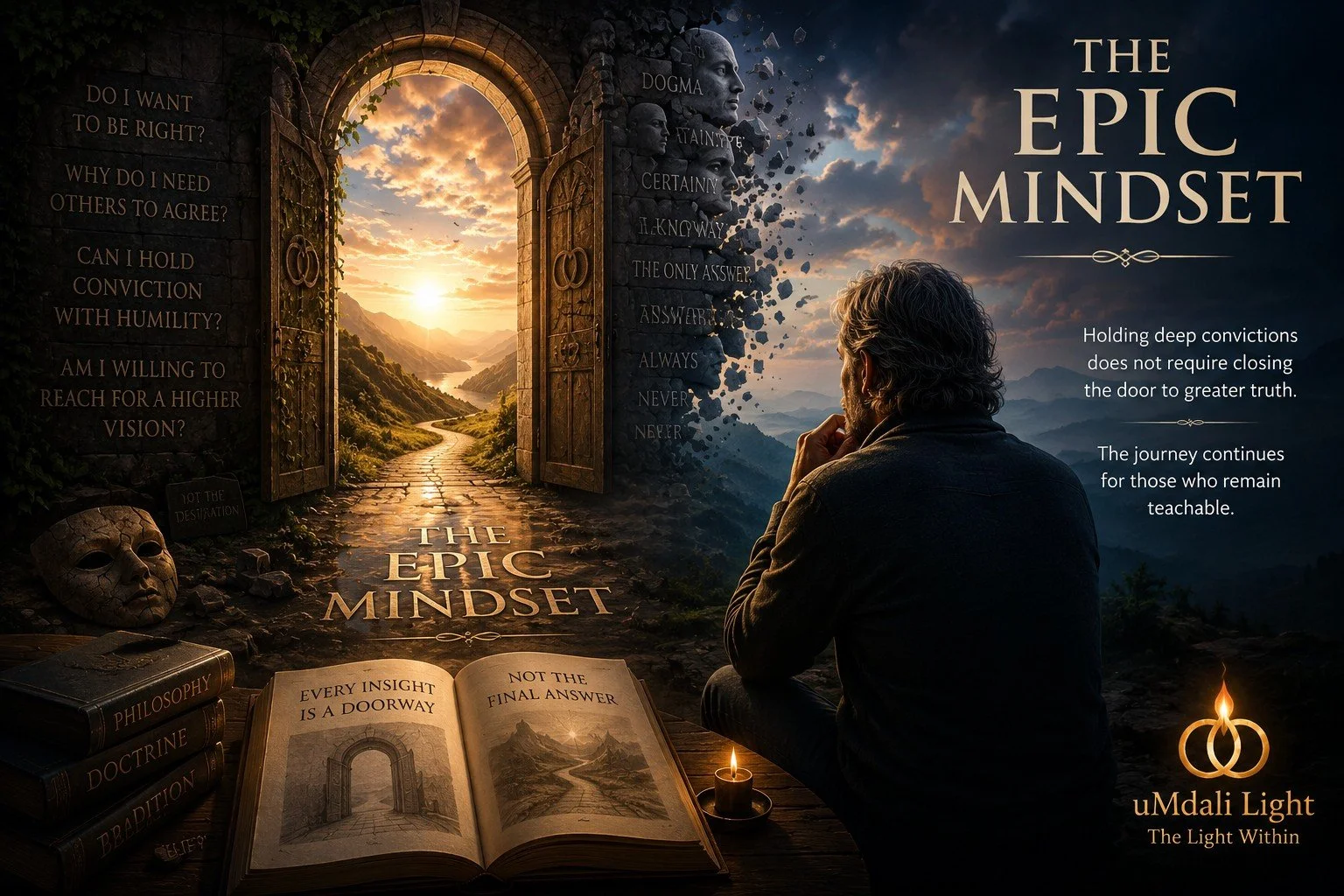
There is a question I have been asking myself lately.
Can I hold my deepest convictions with both confidence and humility?
It is not an easy question.
Most of us believe we are seeking truth. Yet, if we are honest, there are moments when what we seek is really something else entirely. We want to be right. We want our understanding affirmed. We want others to see the world as we do. When they do not, something within us becomes unsettled.
This is what I have come to think of as the epic mindset.
The epic mindset is the subtle human habit of enlarging the self—of mistaking our private convictions for universal laws, and our passing emotions for world-shaping events. It is the inflation of the ordinary into the extraordinary, the elevation of preference into doctrine, the quiet insistence that our view is the view. The only view worth promoting.
It is the ego’s attempt to make itself the center of the story.
Not because the story is truly epic—but because the ego cannot bear to be small.
The epic mindset is not defined by the strength of one’s convictions. Strong convictions have shaped some of history’s greatest moral leaders. Rather, it is the belief that our present understanding is complete—that we have finally reached the summit, arrived at the final answer, and therefore have the responsibility to convince everyone else that we alone possess that truth.
We see this everywhere.
In religion.
In politics.
In academia.
In the workplace.
Even within spiritual communities.
Perhaps especially there.
The ego has a remarkable ability to transform every genuine insight into another reason for feeling separate and superior.
It whispers, Now you understand what others do not.
It tells us that we have finally arrived.
But perhaps awakening is not arriving at all.
Perhaps it is remaining teachable.
One of the greatest obstacles to continued growth is the belief that there is no more growth to be had. Look around our planet. We see it everywhere. Once we believe we possess the truth completely, growth quietly comes to an end.
We don’t have to grow.
We know the truth.
This is why I have come to value the idea of progressive revelation. By this I do not mean that truth itself continually changes. Rather, our capacity to perceive truth continues to deepen if we are endeavoring to expand. Every genuine insight becomes another doorway, not the final destination.
The moment we believe we have reached the highest possible understanding, we quietly stop looking beyond it.
The journey ends—not because truth has been exhausted, but because curiosity has.
Words themselves remind us of this limitation.
Every philosophy.
Every doctrine.
Every sacred text.
Every book.
Even these words.
They are doorways.
Their purpose is not to replace direct experience but to invite it. When we mistake the doorway for the destination, we stop walking. We stop at the threshold, staring in wonder at what we think we are seeing.
This raises another question.
If greater truth were shown to me tomorrow, would I recognize it? Or would I defend what I already know?
History suggests that this question matters.
The greatest advances in human understanding have often come from those willing to look beyond accepted certainty. The ones who dare step forward. They are often ridiculed and shunned. The tragedy is not that people possess convictions. The tragedy is that convictions can become so tightly woven into identity that questioning them feels like losing oneself.
Perhaps that is why humility is so essential.
Humility is not the absence of conviction.
It is the willingness to admit that reality may always be larger than my present understanding of it.
Maybe the real question is not whether I have found truth.
Maybe the deeper question is this:
Am I still willing to reach for a higher vision than the one I hold today?
Continue the journey...
— uMdali Light 🌿
If these reflections resonate with you, you may also enjoy:
The Illusion of Separation — exploring the belief that we exist apart from one another and the consequences that follow.
Dualistic Consciousness— examining the habit of dividing the world into opposing camps and how awakening begins to dissolve those divisions.