Duality Consciousness
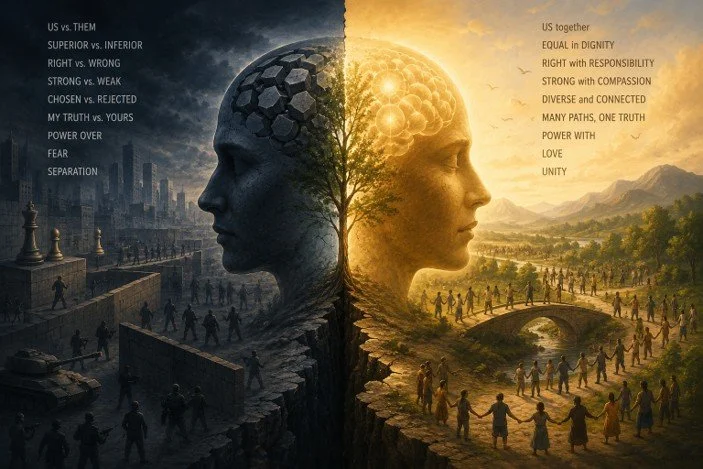
What Do I Mean by Dualistic Consciousness?
Before we begin, a brief clarification: I use the phrase dualistic consciousness in a philosophical and historical sense. I am not referring to Dual Consciousness Theory, a neurological hypothesis associated with split-brain research.
. . . . . . . . .
One of the questions I am asked most often is, "What do you mean by dualistic consciousness?"
It is an important question because the idea lies at the heart of everything I have written.
From the beginning of recorded history, the human mind has organized reality into opposites: light and dark, good and evil, strong and weak, chosen and rejected, superior and inferior. Whether this was humanity’s original state of consciousness is another question. Many spiritual traditions preserve stories of an earlier unity between humanity and the Divine. But within the history we can observe, this way of thinking helped early humanity simplify an extraordinarily complex world. It enabled people to recognize danger, make decisions quickly, and distinguish friend from foe.
In that sense, dualistic thinking was not a mistake. It was a stage of human development.
Every stage of growth carries both gifts and limitations. We would not ask an infant to reason like an adult, nor should we expect early humanity to perceive reality with the same breadth of consciousness that later generations gradually began to discover.
The difficulty arose when the mind began to mistake these distinctions for ultimate reality.
Difference is real. Human beings differ in countless ways. Cultures differ. Religions differ. Languages differ. The problem is not that we notice difference.
The problem is what the dualistic mind does with difference.
It creates distinctions. Then it ranks them.
Male becomes superior, female inferior. One race becomes chosen, another rejected. One nation becomes destined, another expendable. One religion becomes the only path, while all others are dismissed as false.
This is what I mean by dualistic consciousness. It is not merely seeing two things. It is insisting that one must stand above the other—that one possesses greater worth, greater truth, or greater humanity.
History bears witness to where this way of thinking can lead.
Within individuals it creates the masks of superiority and inferiority. Within families it produces the favored and the forgotten. Within societies it hardens into caste, class, racism, nationalism, and systems of exclusion. Entire civilizations have justified conquest, slavery, persecution, and war by convincing themselves that some human beings were inherently more valuable than others.
Unfortunately, we do not have to look only to the past. We continue to see the fruits of this kind of thinking throughout the world today. For those of us who have eyes to see and ears to hear, these observations are deeply painful.
Yet I do not believe dualistic consciousness is evil in its origin. Rather, I believe humanity carried a way of thinking that was once necessary far beyond the point where it served us well.
The tragedy is that what began as a useful way of navigating reality gradually became a prison. The mind learned to divide the world for the sake of survival, then forgot that the divisions themselves were never the deepest truth. We began to mistake the map for the territory, the lens for the reality it was meant to reveal.
Beneath these many divisions, however, I believe there is an even deeper one: the belief that we are separate from the Source that gave us life. Once we experience ourselves as separate from the Divine, it becomes easier to experience ourselves as fundamentally separate from one another. From that first separation, the familiar divisions of “us” and “them” can begin to grow.
Perhaps awakening begins when we question that separation itself.
Again and again, however, history reveals another pattern.
The great spiritual awakenings of humanity tend to move in the opposite direction. While each tradition speaks in its own language, they repeatedly invite us beyond fear, separation, and hierarchy toward a deeper recognition of our shared humanity and our common Source.
This does not require us to erase our differences. It asks us to stop using those differences as measures of human worth.
To move beyond dualistic consciousness is not to stop noticing distinctions. It is to stop making those distinctions the measure of human worth.
History has shown us where that obsession leads.
It is to recognize that beneath every identity, every nation, every religion, every race, and every culture, there is something deeper that has never been divided.
That recognition is what I call awakening.
Continue the Journey. . .
Chapter One, The Birth of Duality, explores this theme in greater depth.